
Basler goes 10GigE, and brings RDMA with it
Basler has announced a 10GigE vision system built around its small ace 2 cameras. It has PoE, it uses RDMA, and Basler sells the cameras, network cards and software together as one matched system.
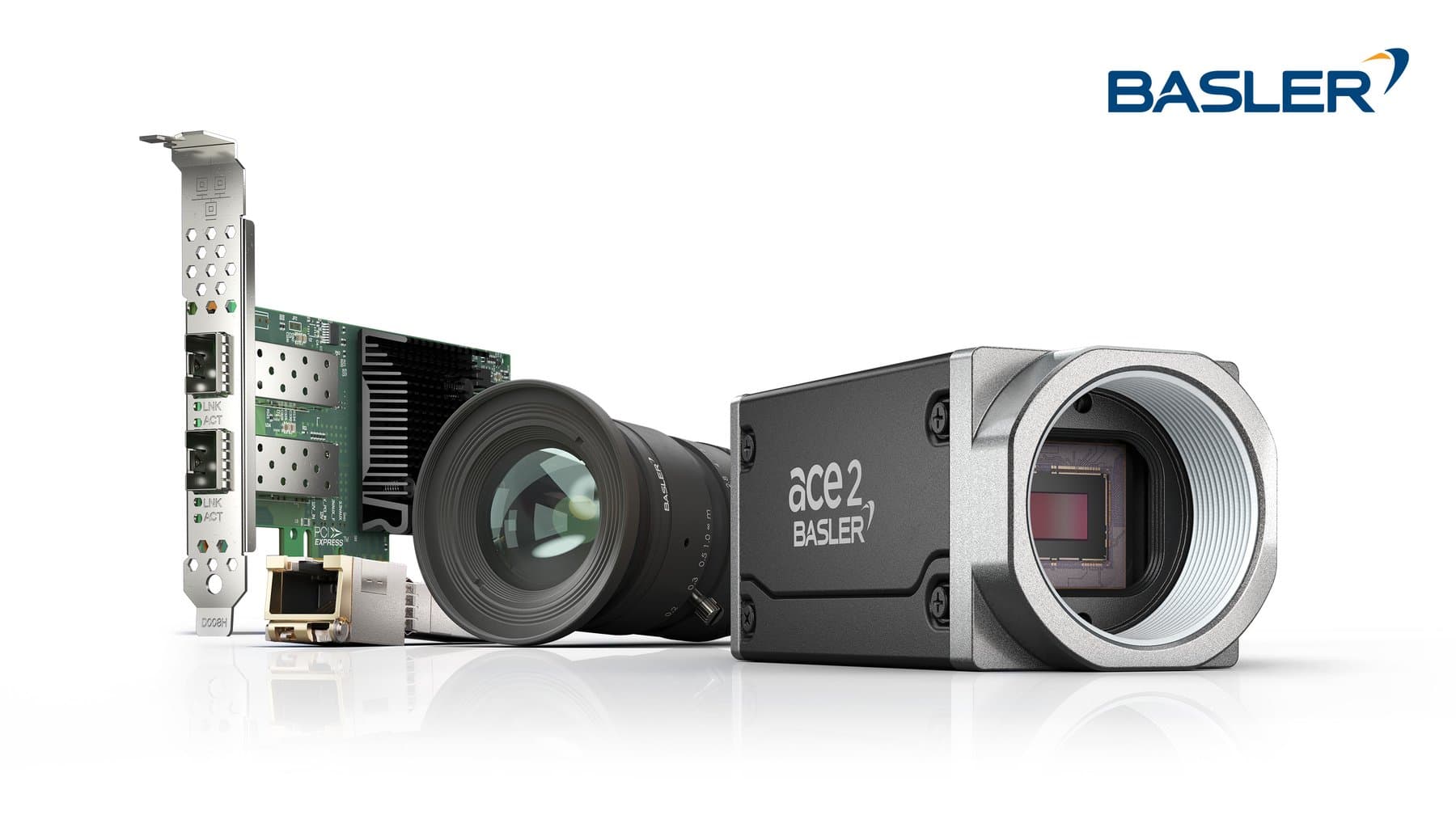
What Basler announced
On 29 September Basler announced a 10GigE vision system built around its compact ace 2 cameras. What caught my eye is that they're selling the whole set, not just a camera: RDMA-capable ace 2 10GigE cameras, 10GigE network cards (RNICs), pylon software with GigE Vision 3.0 support, and the accessories to go with them, like lenses, lighting and cables.
The pitch is one source for the lot, so less complexity, less integration effort and lower cost.
What's in the box
The camera (ace 2 10GigE)
- 29 × 29 × 61.5 mm with an RJ45 connector, and it runs on PoE
- Sony Pregius S sensors (visible and UV), from 5 MP up to 24.4 MP, with up to 232 fps
- Under 7 W power consumption
- RDMA support
The network cards
- RJ45 card: data and PoE down one cable, with cable lengths up to 100 m
- SFP+ card: the cost-effective one. Used with an SFP+ to RJ45 transceiver, it suits professional network setups that need low latency
- RDMA through RoCEv2
The software
- pylon SDK with GigE Vision 3.0 support and optimised RDMA packet handling, on Windows and Linux
- pylon GigE Configurator for setting up the camera and the network card
- pylon vTools (traditional) or pylon AI for the image processing
Why RDMA is the interesting bit
10 Gbit/s is the headline, but the part that makes it work is GigE Vision 3.0, which brings in RoCEv2 (RDMA over Converged Ethernet v2). With it the image data goes by RDMA straight from the network card into the PC's main memory, with no intermediate buffering in the camera and no extra CPU processing along the way.
Basler's claims for that are lower CPU load, very low latency between capture and processing, and enough headroom to run the full 10 Gbps at high frame rates, with image processing and AI analysis still keeping up with production.
In plain English: RDMA lets the network card drop the image straight into the PC's memory, so the CPU isn't busy handling it on the way. It also explains why this is sold as a system. RDMA needs a network card that supports it, and that's what Basler's own RNICs are for.
Where Basler is aiming it
At data-heavy jobs: multi-camera systems, quality inspection, robot control, logistics, wafer inspection and semiconductor manufacturing. Basically anywhere you've got lots of pixels, several cameras, or a decision that has to happen fast after the picture is taken.
What I think
It looks like a neat package on paper: 10 gig in a 29 mm housing with PoE, and the RDMA part is what makes it more than just a faster link. Before I designed anything around it, I'd check:
- Price and availability. Neither is in the release.
- Your software. The benefit comes from GigE Vision 3.0 and RDMA on the host. If your vision software talks to cameras through its own GigE Vision driver rather than pylon, find out whether it supports both before you count on the full effect.
- The host PC. You need one of Basler's RNICs and a free slot for it. There's an RJ45 version (data and PoE on one cable, up to 100 m) and an SFP+ version, so your cabling decides which.
- The numbers. The 10 Gbps, the 232 fps and the lower CPU load are all Basler's figures.
Everything above comes from Basler's press release and 10GigE product page. The specs and claims are Basler's.

Comments
No comments yet. Be the first!