
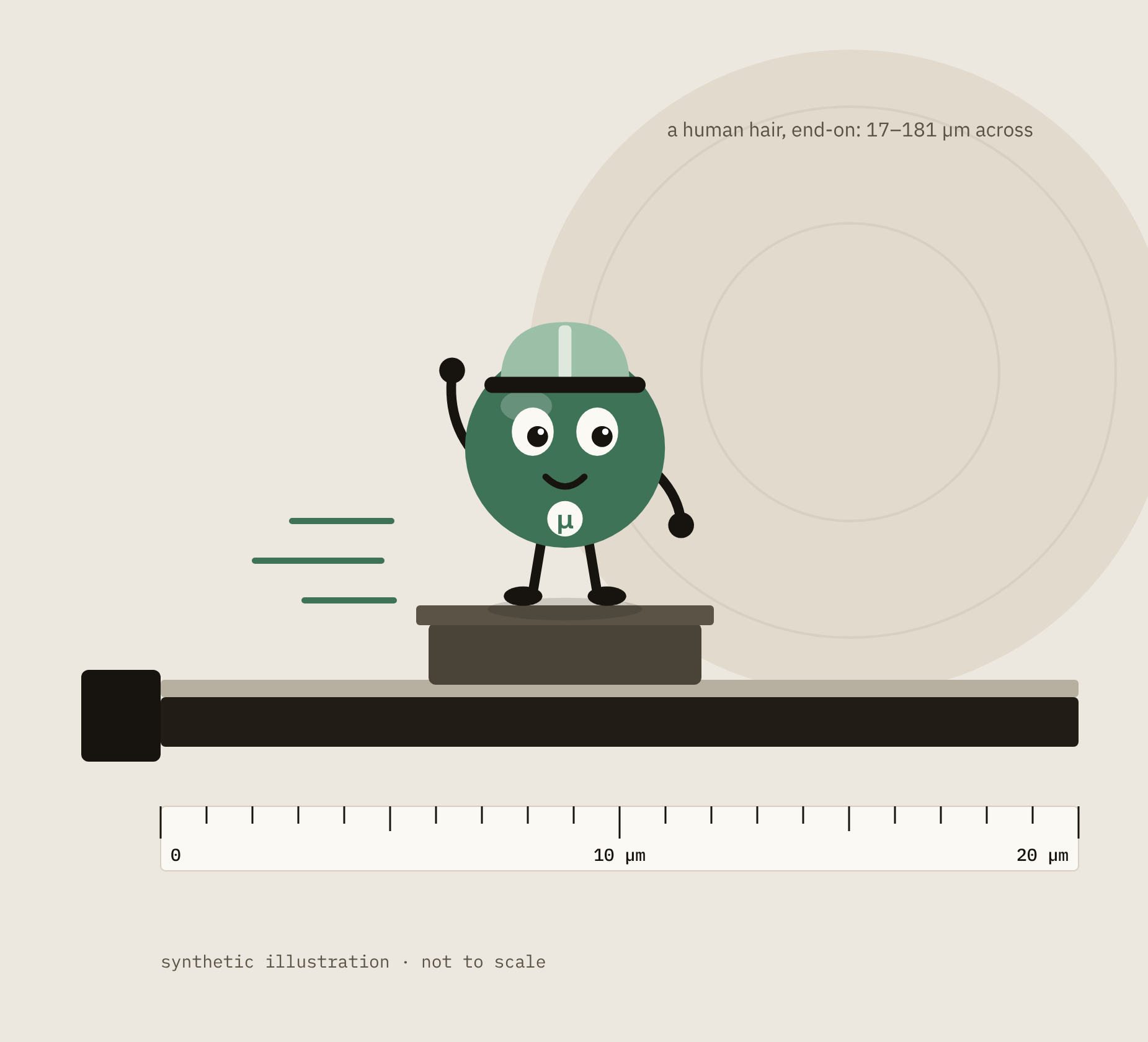
Three ways to move a micron: Jenny Science, PI and Zaber
A first look at Jenny Science, PI and Zaber: what each is known for, in the makers' own published figures, and what “micron-level” really means on a machine.
If you build machines for medical devices, electronics or optics, sooner or later a drawing lands on your desk with a tolerance in microns. At that point the question is no longer "which motor?" but "which way of moving?". A belt-driven axis and a piezo stage can both be called precision motion, yet they solve very different problems.
Three names come up often in that conversation: Jenny Science from Switzerland, PI (Physik Instrumente) from Germany, and Zaber Technologies from Canada. Each is known for a different core technology, but their ranges overlap: all three offer linear motor stages (Jenny Science, PI, via Bio-IT World, Zaber).
This article summarises what each company makes, using the companies' own published information, and sets the three side by side. It does not rank them.
What "micron-level" means
One micron (µm) is a thousandth of a millimetre. When a datasheet says "micron-level", it can mean three different things, and they are easy to mix up:
- Resolution is the smallest step the system can measure or command. It is often set by the position scale or encoder.
- Repeatability is how closely the stage comes back to the same position when you send it there again.
- Accuracy is how far the position it reaches is from the position you asked for.
They can be orders of magnitude apart. Zaber's X-LDM-AE ultra-precision stage, for example, has a linear encoder with 1 nm resolution, an 8 nm minimum incremental move, 80 nm repeatability and 1 µm accuracy (Zaber's figures). So always ask which of the three a number describes, and under what conditions.
Three ways to move
The drawing shows the principles only, not any one maker's product. All three companies offer linear motor stages; PI also builds piezo actuators, and Zaber also offers screw-driven stages (Zaber).
Jenny Science
Jenny Science is a family business in Rain, near Lucerne in Switzerland, established in 1994 (Jenny Science). Its core technology is the linear motor axis: the LINAX linear axes, the ELAX electric slides and the ROTAX rotary axes, all driven by its own XENAX servo controllers (A3). The company describes its motion systems as direct drive.
- Example spec: on its FAQ, Jenny Science gives the LINAX Lxc ±0.4 µm bidirectional repeatability at steady temperature with the 100 nm optical scale, and ±1.5 µm with the 1 µm scale (Jenny Science FAQ). The Lxc product page lists ±0.5 µm in its table, so check the datasheet for the exact figure and its conditions (Lxc page).
- Control: a XENAX Xvi controller is set up in a web browser through its built-in web server, so there is no software to install (Jenny Science). Optional bus modules link it to a PLC over EtherCAT (CoE), POWERLINK (CoP), CANopen, EtherNet/IP or PROFINET (PROFIdrive). Next to those protocols, the Xvi 75V8S page names Beckhoff and OMRON (EtherCAT), B&R (POWERLINK), Allen-Bradley (EtherNet/IP) and Siemens SIMATIC, SIMOTION and SINUMERIK (PROFINET) (Jenny Science). Jenny Science says the modules are mounted and tested during its own assembly, so a customer cannot retrofit them (FAQ); it is worth settling the fieldbus before ordering.
- Notable feature: Forceteq force measurement built into the axis, so forces can be controlled, limited and monitored without a separate force sensor (A3).
- Markets it names: MedTech work such as device assembly, laboratory automation, inspection and functional testing (A3).
PI (Physik Instrumente)
PI was founded in 1970 and is based in Karlsruhe, Germany (PI). Its core technology is piezo actuation; it also makes hexapods, air-bearing stages with magnetic direct drive, and electromagnetic drives (PI, PI USA).
One recent change is worth knowing about. PI signed an agreement to be acquired by HOERBIGER in December 2025, and the deal closed on 31 March 2026. PI says it remains an independent operating entity and keeps its name, brand and global market presence (PI, May 2026).
- Example spec: PI quotes the H-811.I2 miniature hexapod with ±0.06 µm repeatability, 0.08 µm minimum incremental motion and a 5 kg payload, with travel of ±17 mm or ±21° (PI). PI calls these guaranteed values.
- Control: PI's C-887.5x0 hexapod controller, which PI lists as compatible with the H-811.I2, takes commands over TCP/IP or RS-232 using PI's GCS 2.0 command set, and some versions add an EtherCAT interface for a PLC; the customer provides the EtherCAT master with CoE (PI). PI also bought 80% of ACS Motion Control in 2017. ACS makes EtherCAT-based controllers and drives, and its modular systems can manage up to 64 synchronised axes (PI USA, Bio-IT World).
- Notable feature: piezo actuators respond in the sub-millisecond range with sub-nanometre resolution, and have no gears or bearings (PI, via Automation.com).
- Markets it names: industrial automation, photonics, semiconductor, and microscopy and life sciences (PI).
Zaber Technologies
Zaber was founded in 1997 and is based in Vancouver, Canada. Its first product was a linear actuator with a stepper motor and the controller built in, and that idea grew into its T-, A- and X-Series (Zaber). It also offers direct-drive linear motor stages, which Zaber says remove lead screws, ball screws and gearheads (Zaber).
- Example spec: the X-LDM-AE ultra-precision stage has 80 nm repeatability, 1 µm accuracy, an 8 nm minimum incremental move, a 1 nm resolution linear encoder and speeds up to 1.2 m/s, with 60, 110 or 210 mm of travel (Zaber).
- Control: the X-LDM-AE has its controller built in and talks RS-232 with Zaber's ASCII protocol (115200 baud by default), with a USB adapter for a computer's USB port; devices daisy-chain from a single connection (X-LDM-AE manual). Zaber's separate MCC controller family offers RS-232, USB, Ethernet or EtherCAT. Zaber also provides the free Zaber Launcher software and the Zaber Motion Library, its programming interface (Zaber).
- Notable feature: Zaber says it can build, test and ship most of its products within 1 to 5 business days (Zaber).
- Markets it names: photonics and optics, life sciences, microscopy and industrial automation, as examples (Zaber).
The three side by side
| Jenny Science | PI | Zaber | |
|---|---|---|---|
| Headquarters | Rain, Switzerland | Karlsruhe, Germany | Vancouver, Canada |
| Founded | 1994 | 1970 | 1997 |
| Core technology | Linear motor axes | Piezo actuators, hexapods | Stepper-driven stages, built-in controller |
| Also offers | Rotary axes, servo controllers | Air-bearing and linear motor stages | Direct-drive linear motor stages |
| Example spec (maker's figure) | LINAX Lxc: ±0.4 µm repeatability | H-811.I2: ±0.06 µm repeatability | X-LDM-AE: 80 nm repeatability |
| Connects to a PC | Web browser (built-in web server) | TCP/IP or RS-232 (hexapod controller) | RS-232, or USB with an adapter; daisy-chain (X-LDM-AE) |
| Fieldbus to a PLC | Bus modules: EtherCAT, POWERLINK, CANopen, EtherNet/IP, PROFINET | EtherCAT option (hexapod controller); ACS controllers are EtherCAT-based | EtherCAT on MCC controllers (also Ethernet) |
| Markets named | MedTech assembly, lab automation, inspection | Industrial automation, photonics, semiconductor, microscopy | Photonics, life sciences, microscopy, industrial automation |
Table: the makers' own pages, as quoted above. The example specs come from different product types, and each maker measures repeatability its own way (some quote ± values, some a single figure). They show the class of each product, not a ranking.
Comparing them fairly
All three makers combine the same four parts. What differs is which drive, guide and feedback they choose for each product, and those choices, not the brand, set an axis's accuracy, speed and load.
Which one fits depends on the motion range, speed, load and control system of the specific machine. The reliable way to decide is to compare datasheets for the exact axis you need, under the same test conditions.
For a PLC-based machine, the communication side matters as much as the axis. Jenny Science lists five fieldbus modules for its XENAX controllers and says they are fitted at its own factory, PI lists an EtherCAT option on its hexapod controller, and Zaber lists EtherCAT and Ethernet on its MCC controllers. Check that the exact controller version offers the fieldbus your PLC speaks, and whether it has to be chosen at order time.
At AdoptAutomation we integrate precision axes into Omron, Siemens and other PLC-based machines. If you are weighing up options for a new cell, get in touch and we can help you choose.
A note on the facts: the specifications are the makers' own published figures, each one checked against the maker's own page or press release on 27 October 2026. Makers change their products and pages without notice, so check the current datasheet before you order. Jenny Science's own pages differ a little on the Lxc repeatability (±0.4 µm in the FAQ, ±0.5 µm on the product page), which is exactly why the datasheet matters.
A note on the pictures: the picture at the top, the Micron drawings and the two diagrams are illustrations made for this article, not product photos. The logos belong to Jenny Science, PI and Zaber, and are here only to show who is who.
Sources
- Jenny Science — history and family business
- Jenny Science — FAQ, LINAX repeatability and fieldbus modules
- Jenny Science — LINAX Lxc
- Jenny Science — XENAX servo controllers and bus modules
- Jenny Science — XENAX Xvi 75V8S
- Jenny Science at MD&M West 2026 — A3
- ELAX linear slide — A3
- PI — about
- PI — H-811.I2 miniature hexapod (March 2025)
- PI — C-887.5x0 hexapod motion controller
- PI — HOERBIGER completes acquisition (May 2026)
- PI — ring-type piezo actuators, via Automation.com (August 2026)
- ACS Motion Control joins PI — PI USA
- PI acquires ACS — Bio-IT World (March 2017)
- Zaber — about
- Zaber — controllers
- Zaber — direct-drive linear motor stages
- Zaber — X-LDM-AE ultra-precision stage
- Zaber — X-LDM-AE user's manual
- Zaber — linear stages

Comments
No comments yet. Be the first!