
Festo VTUG Valve Manifolds — A Complete Historical & Technical Review
From the world's first valve terminal (1987) to the modern VTUX platform.
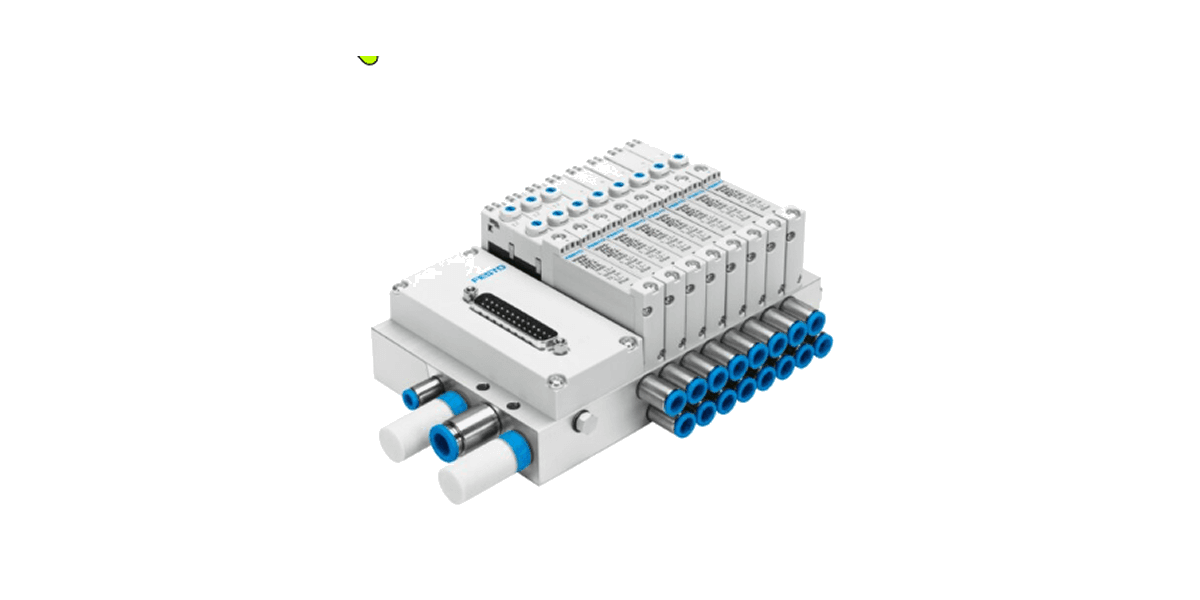
This article covers the VTUG platform. A follow-up article on the VTUX — The New Generation Platform (Festo's 2023 successor to MPA-S and MPA-L) is coming soon.
Introduction
Few innovations have shaped industrial pneumatic automation as profoundly as the valve manifold — and no company has driven its evolution more consistently than Festo. Since 1987, when Festo introduced the world's first valve terminal, the company has systematically developed each successive generation to meet the growing demands of factory automation, process control, and increasingly, Industry 4.0 connectivity.
Over the decades, Festo has released a substantial number of valve terminal families — the CPV, CPA, MPA-S, MPA-L, VTSA, VTOC, VTUS, VTUG, and more recently the VTUX. Each represented the state of the art at the time of its introduction.
This article gives a brief historical overview of the older platform generations to provide context. However, the primary focus of this review is on the two platforms most relevant for engineers specifying systems today: the VTUG — Festo's mature and widely deployed aluminium sub-base terminal — and the VTUX, the brand-new unified platform introduced in 2023.
A Brief History: The Road to VTUG and VTUX
Understanding where the VTUG and VTUX sit in the Festo product family requires a quick look at the generations that came before.
CPV — Where It All Started
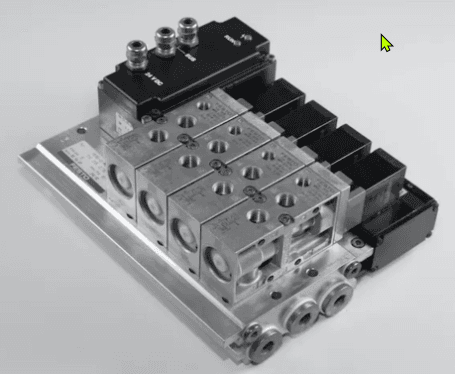
Festo launched the world's first valve terminal, the CPV (Compact Performance Valve). It introduced the revolutionary concept of consolidating multiple solenoid valves onto a single manifold body with shared compressed air channels. The CPV's modular 'valve slice' architecture and fieldbus add-on modules set the template for everything that followed. It is not the right choice for new designs — its communication architecture predates modern fieldbus standards.
CPA — The Economy Option
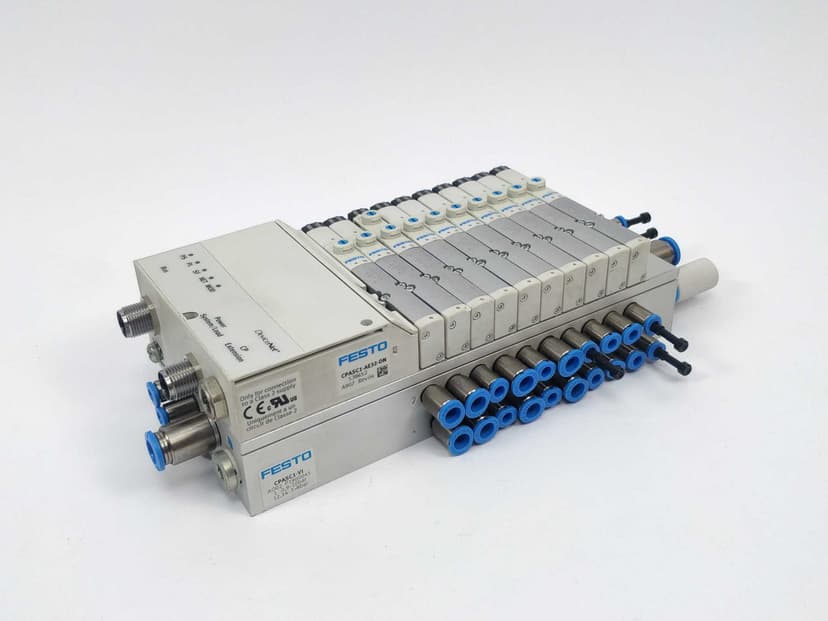
The CPA series followed as a more economical sub-base manifold for applications that did not require the full flexibility of the CPV. Reliable and cost-effective for its time, it is now considered legacy technology.
MPA-S and MPA-L — Fieldbus Takes Centre Stage
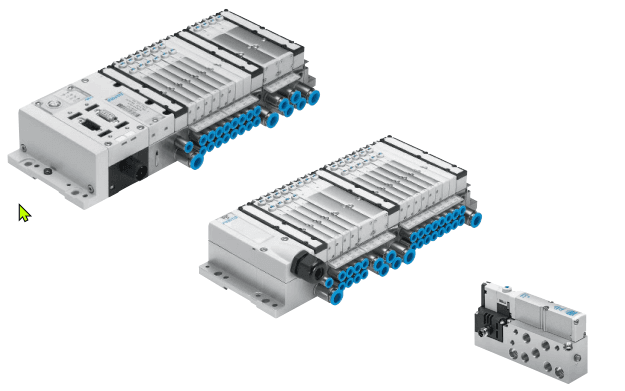
The MPA family emerged as fieldbus communication was becoming standard in manufacturing automation. Offered in two sizes — MPA-S for compact, high-density applications and MPA-L for higher flow rate requirements — it introduced native integration with Festo's CPX automation platform. Festo's own VTUX product literature positions the VTUX as the direct successor to both MPA-S and MPA-L.
VTSA — ISO Standards Compliance
The VTSA addressed a specific need: compliance with ISO 15407-2 and ISO 5599-2 international valve standards. It was the go-to choice for machine builders who needed interchangeable, standards-compliant valve footprints. It integrated with the CPX platform for I/O and fieldbus.
Deep Dive: VTUG — The Proven Workhorse
The VTUG represents the generation immediately before the VTUX and remains a highly relevant, actively supported product.
Architecture and Physical Design
The VTUG is built on an extruded aluminium sub-base, giving it good rigidity and thermal performance while remaining relatively lightweight. Valves mount directly onto the sub-base, which carries internal channels for the compressed air supply, working ports, and exhaust.
A key feature is its support for up to 24 valve positions on a single manifold body. Critically, each position can accept two 3/2-way valves simultaneously, meaning a fully populated VTUG can deliver up to 48 individual valve functions from a single, compact assembly.
Pressure Zoning
The VTUG provides three independent compressed air supply points along the manifold length. Combined with separator plugs that can be inserted at any position, this allows the manifold to be divided into fully independent pressure zones — each fed at a different pressure or from a different supply circuit.
Electrical Connection Options
Electrical flexibility is one of the VTUG's defining strengths. It offers more connection options than almost any previous Festo valve terminal.
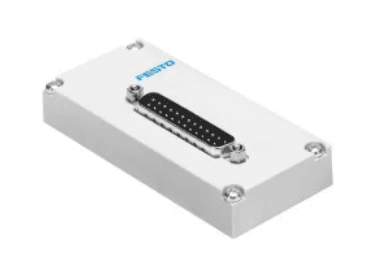
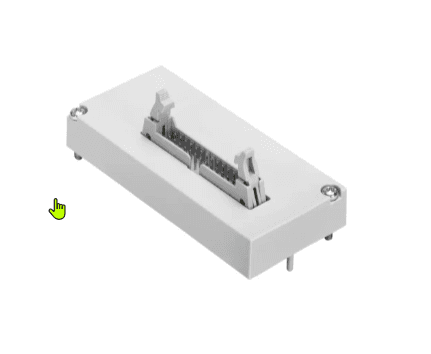
Multi-Pin Plug (Sub-D)
Available in 25-pin Sub-D format for up to 20 valve positions, and 44-pin Sub-D for up to 24 positions. Ideal for simple, cost-effective panel installations where fieldbus communication is not required. No bus node needed — connects directly to a PLC output card.
IO-Link®
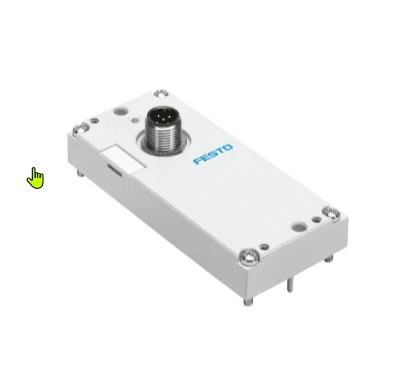
A single 3- or 5-wire standard cable replaces the multi-pin harness, connecting to an IO-Link master. Brings bidirectional communication, parameter download, and diagnostic data. Up to 48 solenoid coils addressable on a single VTUG-PT-L via IO-Link.
I-Port Interface
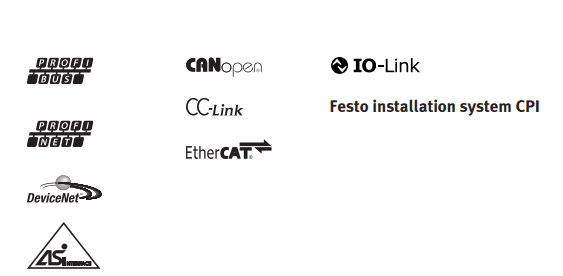
Festo's proprietary single-cable interface that connects the VTUG to CTEU fieldbus modules or CPX bus nodes. A single I-Port cable carries both power and communication data, dramatically reducing wiring. Supports the following protocols through compatible bus nodes:
- PROFIBUS DP
- DeviceNet
- CANopen
- AS-Interface
- CC-Link
- EtherNet/IP
- PROFINET
- EtherCAT
- Modbus TCP
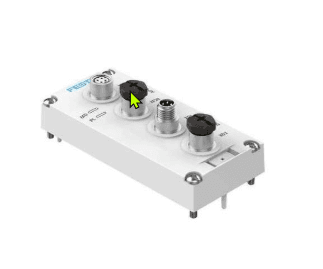
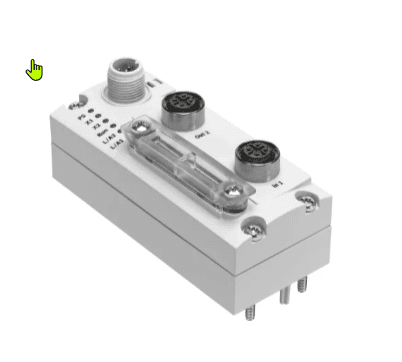
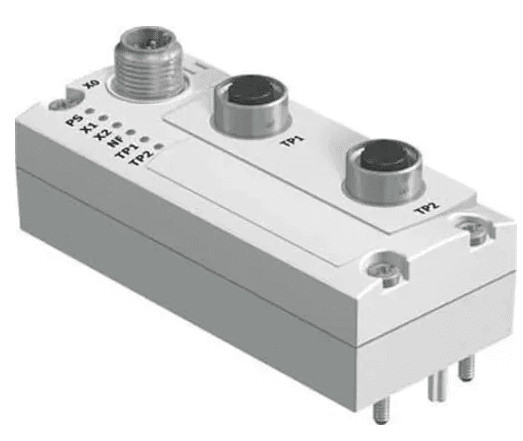
The I-Port interface supports connection of up to 35 solenoid coils per node. Multiple VTUG terminals can be daisy-chained on one I-Port string using the CTEL master, allowing a single fieldbus node to control multiple valve terminals — a significant cost and wiring saving on machines with distributed pneumatic zones.
CPX Terminal (Classic Remote I/O)
When connected to the CPX platform, the VTUG becomes part of a full remote I/O node that can also host digital inputs, digital outputs, analogue I/O, and a fieldbus bus node — all in one compact assembly. From a PLC perspective the combined CPX + VTUG appears as a single fieldbus node.
CPX-E (Compact Controller with Integrated I/O)
The CPX-E adds a built-in programmable automation controller (PAC) to the terminal. The entire valve control logic — including sensor processing, sequence control, and safety interlocks — can run locally without communicating with a central PLC for each cycle. Ideal for semi-autonomous machine modules.
CPX-AP-I (Decentralised Remote I/O)
Festo's next-generation decentralised remote I/O system built around the AP communication bus at 200 Mbaud with a 250 µs cycle time. IP65/67 protection rating on all modules, suitable for installation outside the control cabinet. When connected to the Festo IoT gateway, VTUG data can be forwarded to the cloud via MQTT and OPC UA.
Individual Connection (Per-Valve M12)
Each solenoid coil has its own M12 connector on the manifold face. Adds wiring complexity but gives maximum control flexibility and allows mixed-voltage installations. An M12 splitter module is also available to halve the cable count.
Valve Functions and Sizes
The VTUG accommodates three valve sizes — 10 mm, 14 mm, and 18 mm — providing nominal flow rates of up to 330 l/min, 630 l/min, and 1,200 l/min respectively. All three sizes share the same sub-base footprint, so different valve sizes can be mixed on a single manifold.
| Valve Function | Description |
|---|---|
| 2 × 3/2-way monostable | Two independent valve functions in a single manifold slot |
| 3/2-way monostable | Closed or open position, single solenoid |
| 5/2-way monostable | Single solenoid |
| 5/2-way bistable | Double solenoid |
| 5/3-way mid-position | Pressurised, exhausted, or closed centre |
Protection and Environmental Specs
| Specification | Detail |
|---|---|
| Protection Rating | IP40, IP65, IP67, IP69K — NEMA 4X available |
| Valve Sizes | 10 mm, 14 mm, 18 mm (mixable on same manifold) |
| Max Flow Rate | Up to 1,200 l/min (18 mm valve) |
| Max Positions | 24 positions / up to 48 coils per manifold |
| Air Quality | ISO 8573-1:2010 Class [7:4:4] — 40-micron filtration |
| Corrosion Resistance | CR C2 (humid indoor industrial environments) |
| Pressure Zones | 3 independent supply points with separator plugs |
VTUG: Where It Still Makes Sense
Despite the arrival of the VTUX, the VTUG remains a sound and fully supported choice in several scenarios:
- ✔Upgrading or expanding an existing machine already built around VTUG — maintaining platform consistency simplifies spares and training
- ✔Applications where the CPX or CPX-E integration architecture is already established
- ✔Installations where IO-Link master connectivity is the preferred communication approach
- ✔Projects with procurement or delivery constraints where the VTUG's established supply chain is an advantage
VTUX — The New Generation Platform
The VTUX will be described in detail in a new article coming soon. It is Festo's next-generation unified platform introduced in 2023, positioning as the direct successor to both MPA-S and MPA-L.
Article in progress — check back soon.
This article is an independent technical review for informational purposes. All product names, series designations, and trademarks are the property of Festo SE & Co. KG. Technical specifications should be verified against current Festo product documentation for any design application.
Official Festo VTUG Product Page →
Comments
No comments yet. Be the first!